
Our Approach
Our efforts focus on maintaining ecological balance within oil palm landscapes through the identification, management, and monitoring of High Conservation Value (HCV) and High Carbon Stock (HCS) areas.
We actively manage our HCV areas and HCS areas to sustain their ecological functions and resilience. Our approach is guided by both international and national standards which is strengthened through biodiversity conservation, ecosystem restoration, multi-stakeholder engagement, and collaborations with non-governmental organisations, universities and local communities.
We also apply a landscape and precautionary approach across our operations, ensuring that biodiversity impacts are avoided or minimised, especially in areas close to International Union for Conservation of Nature (IUCN) Category I-IV protected areas, nationally gazetted biodiversity hotspots, or regions recognised under international conventions. Where impacts in our supply chain are identified, they are addressed through restoration and conservation projects under our recovery plan, which form part of the re-entry criteria for suppliers.
Our approach is supported by ongoing monitoring and conservation efforts across our operations. Key progress in safeguarding our conservation areas is summarised below.
| BIODIVERSITY AND CONSERVATION | |
|---|---|
| COMMITMENTS / TARGETS | 2025 PROGRESS |
Uphold our commitment to No Deforestation, including:
Maintain our commitment to No New Development on Peatland, regardless of depth (ongoing). | Zero Deforestation in HCV areas and HCS forests. Zero New Development on peatland in Wilmar’s landbank. |
| Safeguard Biodiversity in Wilmar’s operational areas (ongoing). | 31,876 Ha of HCV Areas and HCS Forests set aside as conservation areas in our oil palm plantations in Indonesia, Malaysia, Ghana and Nigeria (10.4% of our total landbank). 865 Ha of conservation areas in our sugarcane plantations and mills in Australia and India. Regular Monitoring of conservation areas and Zero Deforestation in Wilmar’s operational areas. |
Protect Rare, Threatened and Endangered (RTE) Species of Wildlife to ensure their long-term viability of the species.
Maintain a viable proboscis monkey (Nasalis larvatus) population in Sabahmas | Protect RTE Species of Wildlife in Wilmar’s operational areas through conservation monitoring, awareness-raising programmes and stakeholder engagement. As of 2025, a total of 23 Siamangs have been reintroduced into the wild through the gibbon rehabilitation and reintroduction programme and are protected in PT KSI from a baseline year of 2020. A total of 25 groups of Proboscis Monkeys are monitored and protected in Sabahmas Plantation from a baseline year of 2020. |
For further details on Wilmar’s Conservation efforts, please refer to our 2025 Summary of Progress.
The High Conservation Value (HCV) approach, first developed by the Forest Stewardship Council (FSC), helps identify and manage important environmental and social values within production landscapes. It is now widely applied across forestry, agriculture and aquatic systems, as well as in broader conservation and land-use planning.
The approach is built around six HCV categories, providing a common framework for assessing key conservation values.
The graphic below outlines these six definitions and how the HCV process works.

An HCV assessment interprets what each definition means in the local or national context and determines which HCVs are present, for example, within Wilmar’s conservation areas. The assessment process typically includes:
- Engaging with stakeholders;
- Reviewing existing information; and
- Conducting field surveys where needed.
The results identify the location, condition and importance of each HCV and guide management actions to maintain or enhance these values.
HCV Management Areas (HCVMAs) are parts of a site or landscape where specific actions are needed to protect or improve HCVs.
For planning and mapping purposes, it is important to distinguish between:
- The location of the HCVs themselves; and
- The broader management areas where protection or management measures need to be applied, which may extend beyond the HCV’s immediate boundary.
Designing an effective management regime for HCVs involves:
- Identifying existing and potential threats;
- Defining appropriate management requirements; and
- Delineating zones for total protection or controlled use (e.g., areas that can still support production as long as management practices maintain or enhance HCVs).
| HCV 1 | Concentrations of biological diversity including endemic species, and rare, threatened or endangered species, that are significant at global, regional or national levels. |
| HCV 2 | Intact forest landscapes and large landscape-level ecosystems and ecosystem mosaics that are significant at global, regional or national levels, and that contain viable populations of the great majority of the naturally occurring species in natural patterns of distribution and abundance, |
| HCV 3 | Rare, threatened, or endangered ecosystems, habitats or refugia. |
| HCV 4 | Basic ecosystem services in critical situations, including protection of water catchments and control of erosion of vulnerable soils and slopes. |
| HCV 5 | Sites and resources fundamental for satisfying the basic necessities of local communities or indigenous peoples (for livelihoods, health, nutrition, water, etc...). Identified through engagement with these communities or indigenous peoples. |
| HCV 6 | Sites, resources, habitats and landscapes of global or national cultural, archaeological or historical significance, and/or of critical cultural, ecological, economic or religious/sacred importance for the traditional cultures of local communities or indigenous peoples. Identified through engagement with these local communities or indigenous peoples. |
Source: HCV Common Guidance Toolkit
 All areas that are identified as HCV, HCS or riparian areas, are categorized by Wilmar as conservation areas and are actively managed and monitored under Wilmar's conservation management programme based on the principles of our biodiversity conservation commitments. This categorization may differ from the reporting definitions set by RSPO ACOP.
Comprehensive and robust HCV assessments are conducted by independent experts and peer-reviewed by the HCV Resource Network before any land clearing or new plantation development commences. We had been using RSPO Approved Assessors in all our assessments, and subsequently HCV Licensed Assessors when the Assessor Licensing Scheme was launched in Jan 2015. Since the convergence of the HCV-HCS integrated methodology in 2016, assessments covering both HCV and HCS are carried out jointly and quality assured under the ALS.
If HCV-HCS are present in our sites, we implement the following measures:
- Formulate management plans to manage and protect the HCV-HCS areas that have been identified;
- The management plans will include the schedule for monitoring the HCV-HCS areas to ensure that no illegal activities i.e. logging, mining and poaching occur. In the HCV-HCS areas identified for its cultural values, our monitoring plan is to ensure that the boundaries are respected and that there are no illegal activities such as encroachment by external parties into the area. For HCV-HCS areas identified to harbour endangered, rare or threatened species, our monitoring will include periodical biological monitoring and inventory of species and ensure that the records are sent to the local government office for their records.
- In areas where there has been historical degradation on HCV-HCS or any non-compliant land clearing within our concession as per our NDPE cutoff date, restoration and reforestation activities are undertaken to enhance the conservation values identified and to improve landscape connectivity.
Our monitoring programme has been put in place since 2004 and we have recorded no illegal and/or deforestation cases in our own operations as at end of 2023.
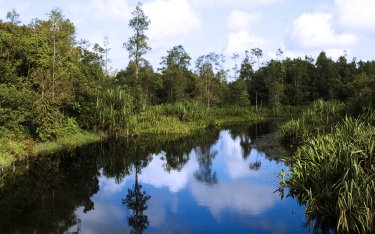
High Carbon Stock (HCS) forests are natural forests that contain a large concentration of carbon in their vegetation and soil, making them crucial for mitigating climate change. Hence, HCS forests need to be protected and not be cleared for new farm or plantation development.
Deforestation of HCS not only releases this stored carbon but also destroy the habitats of many flora and fauna. Protecting HCS forest prevents the release of greenhouse gases, helps regulate local and global climate and preserves unique ecosystems and species.
In line with our No Deforestation, No Peat, No Exploitation (NDPE) Policy, Wilmar adheres to the HCS Approach which is a methodology that distinguishes forests areas for protection from degraded lands with low carbon and biodiversity values that may be developed. It aims to balance ecological and environmental values with the customary rights of indigenous peoples and benefits to local communities.

Smallholder Programmes
Integrating smallholders into the global sustainable supply chain.

Traceable Supply Chain
Supply chain map and traceability statistics.

Supply Chain Transformation
Driving real change on the ground with Aggregator Refinery Transformation (ART) and Proactive Surveillance.
